
Long ago, I thought I saw statistics implying that when normal Christians switch religious affiliations, often this is to a different Christian denomination, but when Mormons switch affiliations it almost always is to go straight to atheism. Indeed, I don’t know of any Mormons who have switched to being typical protestants, but I know of many who have completely left Christianity. Since I couldn’t find said statistics, I generated my own from this data from the USA (interestingly, in the newer dataset here, pew says the variable for family religion is “restricted” – so I had to use the 2014 dataset. Why would they now hide that variable?).
The point is to illustrate the thesis that:
Mormons doctrine is much more complete than typical protestant doctrine. Firstly, because we have the Book of Mormon, which though taking place during the same time period as the Bible is without much of the tampering and translation errors that the Bible has gone through. And secondly, because we also have modern day revelation as recorded in the Doctrine and Covenants. I have tried to illustrate some of these differences in doctrine in 7 Essential Principles from Mormonism for you to understand.
Thus, compared to other Christian denominations, Mormons tend to see other religious doctrines as unappealing and illogical – and thus are much more likely to go straight to atheism compared to other religions.
Results
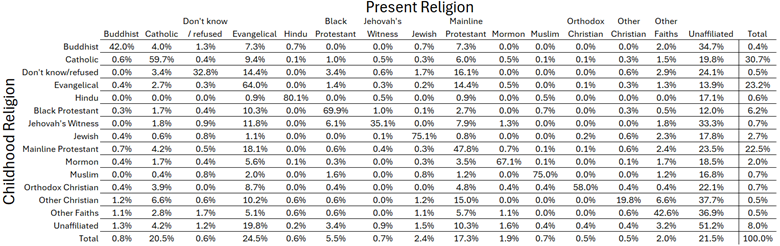
Here is the table I produced illustrating which religion people tend to identify with, given their childhood religion (and all my code is here).
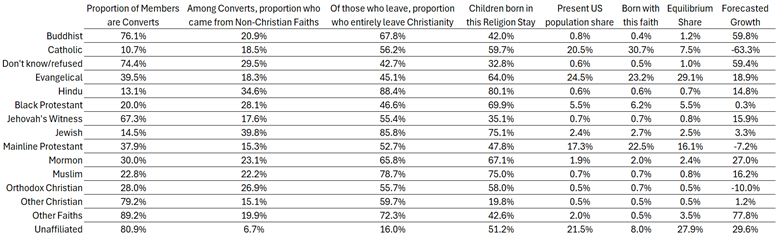
I also produced the following table providing more condensed information for each religion. And to note – I created the column “Equilibrium Share” by extrapolatign the equilibrium population of each religion if we assume the proportion of people who leave one religion to another as described in the above table holds (using the basic logic behind markov chains):
Some notes before conclusions
A note on forecasted growth: My model of course is very basic, and doesn’t account for how more people are likely to join a religion if it becomes bigger due to higher exposure to the world (especially with regard to Mormonism due to our missionary culture). Thus, the values in the column “Forecasted Growth” (which simply compares the equilibrium population share to the current population share) are probably less extreme than they should be. Likewise, this model also fails to account for birth rates – as I show later in this article Mormons have much higher birth rates than other denominations. By virtue of these two facts, the projected growth of Mormonism (27%) which is higher than all other Christian religions, is likely even higher.
Regarding proportion of the population with a mormon childhood religion. The astute reader is probably wondering how the model could forecast growth in the Mormon church, when apparently the proportion of the population born Mormon is higher than currently identifying as Mormon. Well, the short answer to that question is – I have triple checked all my math, and by virtue of the nature of Markov chains, there is only a single equilibrium population share, and all other types of populations will converge in the long run to that equilibrium – thus if the proportion Mormon is projected to grow, then there must be hidden variables explaining that. One hidden variable might be that Mormon converts tend to come from non-Christian backgrounds more than other religions, and religiously unaffiliated is expected to hugely grow. Another variable might be that mormons stay in their childhood religion at a higher rate than all other Christian religions.
At any rate, it’s likely just an artifact of the data that proportion of children born Mormon is .1% lower than proportion of the population identifying as Mormon, because most statistics show that Mormonism is growing in the USA (which I will discuss later in this article).
Larger Conclusions
As the numbers show, the original thesis that Mormons tend to go straight to not believing in God at all is correct: 65.8% of those who leave Mormonism go directly to not believing in Christianity entirely, compared to 45.1% of evangelicals; I suspect the difference in populations here is even larger if you specifically look at active Mormons. As said, I believe this corroborates the idea that Mormons tend to view their theological ideas as nearly “perfect” compared to other religions (speaking in terms of population averages), thus from the Mormon mind, if he is going to leave Mormonism, he might as well go entirely to atheism.
The growth of the Mormon Church
Here are few further statistics corroborating my model’s prediction that the Mormon church should be growing:
- Utah has 2.2 Million Mormons, which is 68.55% its population. Overall, the US has 6.8 million Mormons. There are 17 million mormons worldwide.
- Mormon church official statistics show growth across the world (source).
- Mormon church official stats also show growth just within the USA (source).
- Of course, just because membership grows doesn’t mean a church is true. This person appears to have analyzed the numbers much more than me.
- Pew Research reported 1.7% of the US population was mormon in 2007, 1.6% in 2014, and 2% in 2023.
Leave a Reply