

Groundsel trees grow to be very white and fluffy.
I dreamt of being taught how there is a special order to how gospel principles are taught seen in the thirteen articles of faith which is similar to my written views and the scriptures, in that baptism came first and then the virtues came last. Basically, I was under the impression that the true gospel in the scriptures was taught in a specific order, since having the right order mattered, and you could particularly see this order within the thirteen articles faith, though it was present in all the scriptures.
I also had a demonic astral projection, in which an entity pretended to be my mom, tried to wake me up, tried to persuade me that it was indeed real, and said it had seen my dreams and appreciated them. Strange.
The Perfect order of the Articles
Here are the thirteen articles of faith:
1 We believe in God, the Eternal Father, and in His Son, Jesus Christ, and in the Holy Ghost.
2 We believe that men will be punished for their own sins, and not for Adam’s transgression.
3 We believe that through the Atonement of Christ, all mankind may be saved, by obedience to the laws and ordinances of the Gospel.
4 We believe that the first principles and ordinances of the Gospel are: first, Faith in the Lord Jesus Christ; second, Repentance; third, Baptism by immersion for the remission of sins; fourth, Laying on of hands for the gift of the Holy Ghost.
5 We believe that a man must be called of God, by prophecy, and by the laying on of hands by those who are in authority, to preach the Gospel and administer in the ordinances thereof.
6 We believe in the same organization that existed in the Primitive Church, namely, apostles, prophets, pastors, teachers, evangelists, and so forth.
7 We believe in the gift of tongues, prophecy, revelation, visions, healing, interpretation of tongues, and so forth.
8 We believe the Bible to be the word of God as far as it is translated correctly; we also believe the Book of Mormon to be the word of God.
9 We believe all that God has revealed, all that He does now reveal, and we believe that He will yet reveal many great and important things pertaining to the Kingdom of God.
10 We believe in the literal gathering of Israel and in the restoration of the Ten Tribes; that Zion (the New Jerusalem) will be built upon the American continent; that Christ will reign personally upon the earth; and, that the earth will be renewed and receive its paradisiacal glory.
11 We claim the privilege of worshiping Almighty God according to the dictates of our own conscience, and allow all men the same privilege, let them worship how, where, or what they may.
12 We believe in being subject to kings, presidents, rulers, and magistrates, in obeying, honoring, and sustaining the law.
13 We believe in being honest, true, chaste, benevolent, virtuous, and in doing good to all men; indeed, we may say that we follow the admonition of Paul—We believe all things, we hope all things, we have endured many things, and hope to be able to endure all things. If there is anything virtuous, lovely, or of good report or praiseworthy, we seek after these things.
And here is the basic structure I see in these articles:
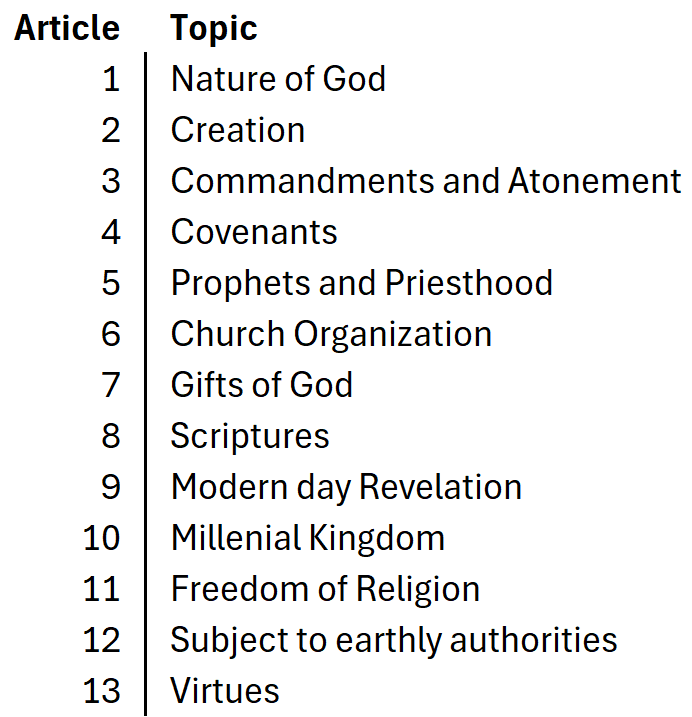
I think this order makes perfect sense: Nothing in the gospel will make sense unless you first explain the nature of God (#1), and the nature of God won’t entirely make sense unless you explain why God is God – because he created the world (#2 the creation). Once you explain the creation, the next most logical step is to then explain what we should do about the fact that god is God: namely, we should follow His commandments. And naturally, the commandments go along with the atonement – as the atonement is the remedy if we break the commandments, and because the atonement helps change us so we can follow the commandment (#3 commandments and atonement).
Once you understand the existence of the atonement, it now makes sense to explain how you access the power of Christ’s atoning blood – via covenants and baptism (#4). Which then naturally leads to the question of how said covenants are administered, which is of course via the priesthood (#5). This then raises the question: where did the priesthood come from, to which it now becomes necessary to explain the church organization (#6).
Once you understand the existence of the church organization, it then makes sense to explain why God’s true church organization is different from the worldly churches: which is that the true church operates through God’s power via gifts of God (#7). And the discussion of God’s gifts naturally leads to the scriptures (#8), since the scriptures are the main consequence of God’s gifts manifested among men.
Since many people get stuck on the scriptures, it then becomes necessary to clarify that there also is modern day revelation (#9) – after all, there still are many A. mysteries of the kingdom of heaven, B. instructions for the saints, C. prophecies of the future, D. important hidden things of the world and lost things to history, and E. instructions on how to be the salt of the earth that we still don’t have yet in the scriptures.
With the understanding that modern day revelation exists, it then makes sense to explain the primary purpose of this revelation: to help ready the world for the millennial kingdom, which will come very, very soon (#10). But since God’s kingdom still doesn’t exist yet on earth, it then makes sense to explain how we deal with worldly government in the meantime: namely that we think that there should be freedom of religion (#11), and that we are OK with being subject to earthly government (#12).
The final article of faith, number thirteen, which discusses the virtues (#13), makes sense to be the last point because: A) it isn’t a necessary piece of information to understand any of the other points, and B) cultivating these virtues ties into the idea of enduring to the end, which becomes more important only once you have already accepted the more basic points of the gospel.
Scriptural Precedent
In alignment with the dream, it does seem as though the order of the doctrines of the articles of faith reflects a larger trend throughout scripture. Here are a few examples:
Alma’s discourse to Zeezrom:
Alma 12:15 – nature of God
Alma 12:16-18 – commandments and atonement
Alma 12:21-26 – fall of Adam (part of creation)
Alma 12:27-32 – further discussion of commandments and atonement
Alma 12:33-37 – repentance, a part of covenants
Alma 13:1-2 – prophets and priesthood
Alma 13:3-19 – organization of Church
Alma 13:20 – scriptures
Alma 13:22 – modern day revelation (for their time).
Alma 13:24-25 – millennial kingdom
Alma 13:28 – virtues.
Ammon teaching king Lamoni:
Alma 18:24-32 – nature of God
Alma 18:36 – creation
Alma 18:39 – atonement
* Long break because the king falls unconscious.
Alma 19:35-36 – baptism / covenants
Alma 20:1 – church organization
Aaron teaching king Lamoni’s father:
Alma 22:7-10 – nature of God
Alma 22:10-13 – creation and fall of Adam
Alma 22:13-14 – sins and atonement
Alma 22:15-18 – covenants
Do the articles of faith miss anything?
In my view, these scriptures and the articles of faith somewhat provide only shadows of a larger grand order to the gospel. Thus, just as these scriptures miss a few things contained in the articles of faith, so too do the articles of faith miss a few minor points taught in the scriptures. Namely, I think the articles of faith don’t properly discuss these elements of the gospel:
- Satan is a real entity who influences our minds and world events, particularly through our flesh, technology, and worldly institutions.
- The idea of a plan of salvation, as well as the three kingdoms of glory and outer darkness in the afterlife.
- Opposition in all things and temptation so that we can choose between good and evil.
- Developing a relationship with God through prayer and scripture study.
But of course, there are many other elements of the gospel beyond this. As of writing this, I have an LLM on my computer traversing every verse in the standard works to provide the verse a score across 260 different gospel topics (similar to what I did for flood stories). Said program will probably take at least a week to finish running, but once it completes, I will be able to do a lot of interesting statistics. These include discovering the typical structure of the gospel, as taught in the scriptures, as well as the order in which gospel topics usually are arranged within scripture passages, which would all be very useful in creating gospel manuals that follow the *correct* pattern.
Leave a Reply