
Thesis
Unfortunately, many modern Christians do not understand the trinity nor the Nicene Creed and therefore have convinced themselves that my views on the nature of God – as described in Proving Jesus is Separate from God the Father with the Scriptures – are against fundamental Christian doctrine. Let me correct this.
The trinity holds that God the Father, Jesus Christ, and the Holy Ghost are three distinct persons with the same substance. I agree with this – this does NOT go against my views, since if Jesus Christ is the son of God the Father, then by nature Jesus must be of the same substance as God the Father.
Ironically, my views actually align with the Trinity much more than the views of many modern Christians, who actually believe in practical modalism, though they tell themselves that they believe in the Trinity. According to practical modalism, God the Father, Jesus Christ, and the Holy Ghost are actually the same person – and they only have the appearance of being different because God sometimes manifests himself differently. Thus, when God manifests himself in the flesh, he happens to be called Jesus Christ, and when he manifests himself in the spirit, he is called the Holy Ghost, but these were always actually the same person.
Modalism has been rejected by the early Christian church up all the way until recently when “Practical Modalism” started to become popular, due to the fact that the Trinity holds that God the Father and Jesus Christ are “distinct persons”, whereas practical modalism says they are the same person. I think practical modalism is making a resurgence because Satan intends to create a one world religion, and when you introduce the idea that God has different manifestations which can seem like different beings even though they are not, that invites the idea that “Allah” or Ik Onkar (the God in Sikhism) are also just different manifestations of God – thus facilitating the unification of world religions underneath the Antichrist.
My only qualm with the Trinity is that I think it is unnecessarily confusing to people to simultaneously say that God the Father is the same as Jesus Christ but also say that he is different. I understand why they did this – it makes sense cosmologically to say there is only one God, yet the New Testament only makes sense if you understand Jesus Christ to be separate from God the Father, however it also seems like it would be disrespectful to say that Jesus Christ is not God. Therefore, saying that God the Father and Jesus Christ are different persons of one substance perfectly threads the needle of having one God without contradicting all the scriptures that make Jesus out as different from God the Father.
My view though is that Jesus knows he is different from God the Father and isn’t offended if we say this – therefore we don’t need to constantly emphasize that they are actually the same.
The consequence of the willfully confusing definition of the trinity is that the confusion opens the door to Satan corrupting people’s view of God – as seen in the introduction of practical modalism to the modern church. To be clear, I do think the trinity is technically correct. Practical modalism, on the other hand, is completely false, and is wrong, and bad, and needs to be stopped. Thus, my main objection with the trinity is not that it is false, but that its unnecessary obsession with 1+1+1=1 has led Christians to the great heresy of modalism.
What’s worse though is that modern Christian churches have recently started to falsify the definition of the Nicene Creed to make it seem like Modalism is true – via saying that Jesus is the same being as God the Father, when the creed actually said that Jesus is the same substance as the father – a big difference, because the Trinity holds that Jesus is not actually the same being as God the Father, since they are distinct persons.
Therefore, in this essay I will explain in depth the translation of the Nicene Creed and prove that it has been falsified in modern times. I will also provide here some quotes substantiating my claims regarding practical modalism, including an excellent article from the Anglican Church which basically says all the same things I have said here regarding modalism.
Full text of the Nicene Creed
Here is an old English translation of the creed from 1662:
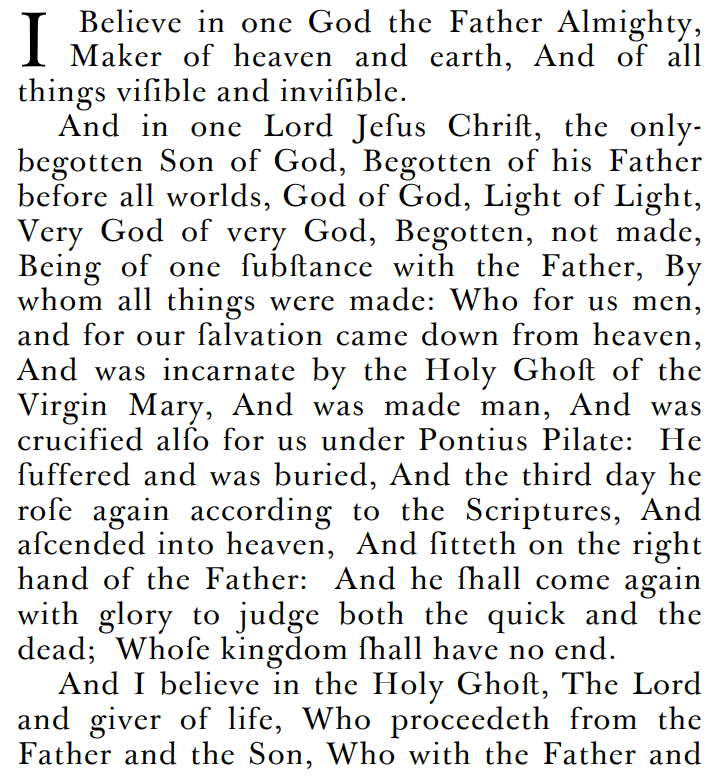
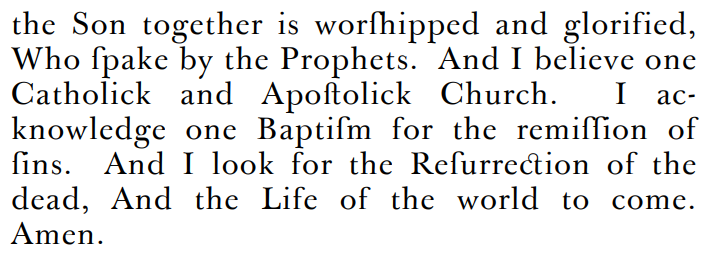
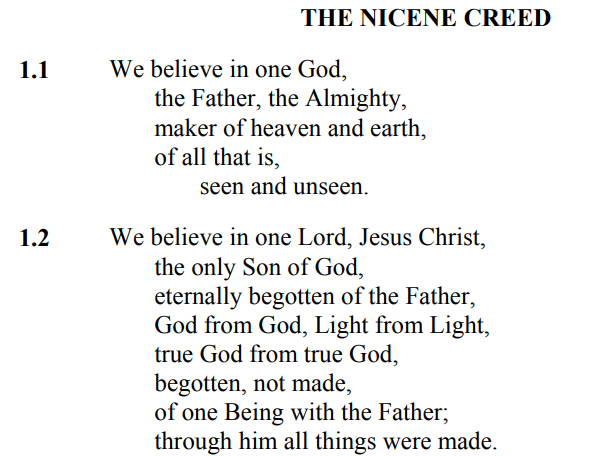
As you can see, the Nicene creed DOES NOT say that Jesus is the same being as God the Father. Rather, it says that Jesus is “of one substance with the father” – which is of course true, as every son is of the same substance as his father.
Corrupt Christian Denominations Changing the Text
Anglican Church
The issue with the Nicene Creed is that modern denominations have been systematically changing the text of the creed to say that Jesus is “of one being” with the Father – rather than say that he is of one substance with the father. This of course hugely changes the meaning in that while a son is indeed of one substance with his father, he is not literally the same being as his father.
This modern version can be seen in anglicansonline, which reads “of one Being with the Father” (source).
This contradicts the 1662 Book of Common Prayer, in which we can see that the Anglican church used to translate the Nicene Text as saying:
“being of one substance with the Father” (source)
Therefore, evidently the Anglicans used to agree with me regarding the translation, but *something* made them corrupt the text recently.
Lutheran Church
According to the 1941 Lutheran Hymnal (here), Jesus is “Being of one substance with the Father” – as you can see in this screenshot:
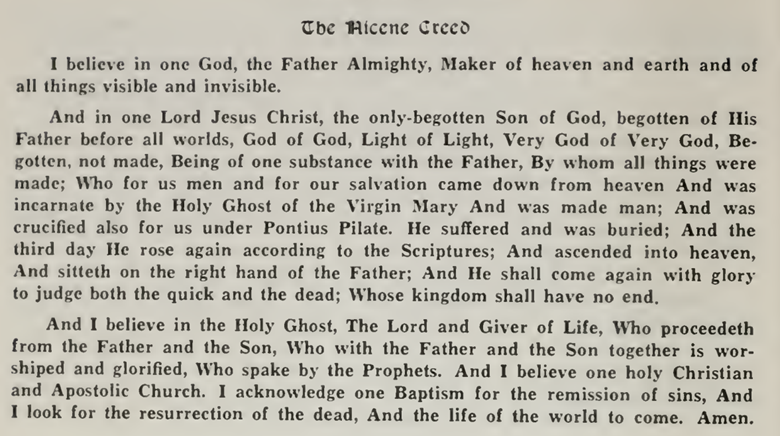
However, the modern Lutheran Church has now changed the text to say that Jesus is “of one Being with the Father” (source) – a further example of how churches have recently been changing the Nicene Creed’s text.
Presbyterian Church
Likewise, the old presbyterian church quotes the Nicene Creed as saying of one substance, according to the Presbyterian’s 1946 Book of Common Worship (source):
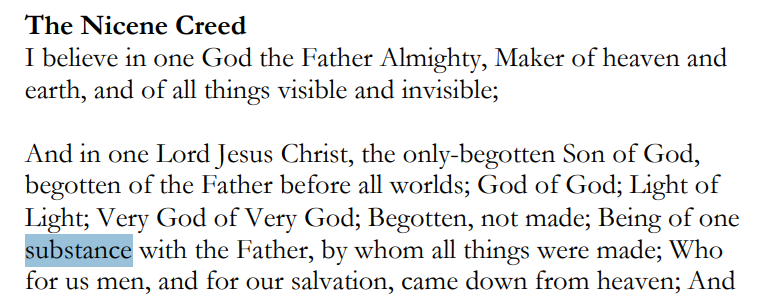
Nevertheless, yet again the modern Presbyterians have changed the text to instead say that Jesus is of One Being (2016 The Constitution of the Presbyterian Church).
Nevertheless, a great many churches still have the correct translation
Roman Catholic Church – “begotten, not made, consubstantial with the Father” (source)
Baptists – “being of one substance with the Father” (source)
Greek Orthodox Church – “of one essence with the Father through Whom all things were made” (source)
Orthodox Church of America – “of one essence with the Father” (source)
Christian Reformed Church in North America – “of the same essence as the Father.” (source)
Bibles.net – “of the same essence as the Father.” (source)
Early church texts – “of one substance with the Father” (source)
Looking for ourselves at the Greek text
The general pattern I have observed across the modern world across various realms – history, philosophy, and most importantly, the scriptures – is a corruption and subversion of modern texts to obscure the truth, while the older texts remain accurate. Therefore, for me personally it is sufficient to see that the old English version of the Nicene creed said “of one substance” to know that this is the correct translation. But lest you, my dear reader, still think “of one being” is also a valid translation choice, let me dispel this idea. As I will show, the decision to translate it as “of one being” – was not a *subjective* choice. It just is incorrect, flat out wrong, and against our knowledge of Greek – and the main motivation to do this would be to subvert people’s understanding of God.
For reference, this page from earlychurchtexts provides the original Greek text of the Nicene creed along with the English translation (and their English translation is correct – it says “of one substance with the Father”). So here is the specific Greek text of concern:
ὁμοούσιον τῷ Πατρί – which translates to “consubstantial with the Father”, though evil people want it to mean “of one being with the Father”.
And this is the specific word of concern: ὁμοούσιον, which is pronounced “ho-mo-OO-see-on”. This word’s roots are ὁμο- (homo), and οὐσίᾱ (ousia), meaning literally “same essence” (though workers of evil would like to translate this as meaning “one being”).
This is what οὐσίᾱ means according to Wiktionary:
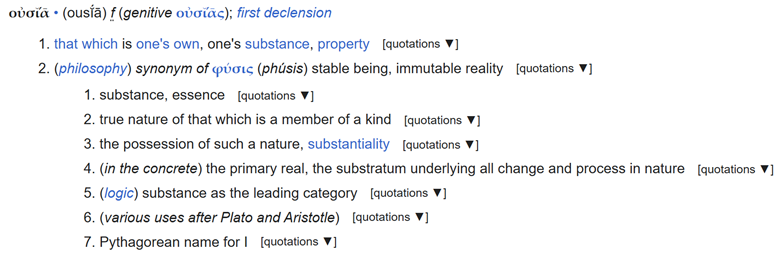
Thus, it simply means “essence”, not “being” [if you want to be pedantic, there are a handful of sources which add that a minor definition could be “being”, but none of them are saying this is the main definition, and only add this due to the word’s relevance to Greek texts about the trinity – thus, this isn’t a standard teaching of Greek. This is actually a great example of how fools invert the evaluation of historical sources – instead of painstakingly analyzing source documents to come to conclusions, they are allowing their preconceived beliefs to change the way they interpret sources – in this case meaning they are literally trying to change the definition of Greek words to uphold their theological worldview.]
If the Greeks had wanted to say that Jesus is the same being as God, they would have simply said “Jesus is God” – meaning, they would have used the word “is”, which is translated as “είναι”. And this is just plainly true: what normal person says “Jesus is consubstantial to God”, when they really meant “Jesus is God”, and they could easily have just said so plainly.
The english word “Essence” literally comes from οὐσίᾱ
This is what the Wikipedia article for essence says:
“The English word essence comes from Latin essentia, via French essence. The original Latin word was created purposefully, by Ancient Roman philosophers, in order to provide an adequate Latin translation for the Greek term ousia.”
Therefore, if the English word for “essence” descends from the Greek word “ousia”, then it should be plain that the Greek word ousia (οὐσίᾱ) means “essence”, not “being”.
The Catholic Church understands this
The Catholic church has a great article about why the Nicene creed should be translated as meaning “of one substance” rather than “one Being”, titled Consubstantial with the Father, which reads:
When these two ancient creeds were translated into Latin, the term ” homoousion” was rendered as ” consubstantialem,” that is, “the same substance of the Father.” Prior to the Second Vatican Council, the Latin ” consubstantialem” was rendered as “consubstantial” within the English translation of the Creed. Many theologians and the Holy See thought that the term “consubstantial” was more in keeping with the Latin tradition and a more literal and accurate translation than the more recent “one in being.”
This is in keeping with the mind of the Congregation for Divine Worship and the Discipline of the Sacraments, which published an Instruction, entitled Liturgiam Authenticam. It stated: “Certain expressions that belong to the heritage of the whole or of a great part of the ancient Church, as well as others that have become part of the general human patrimony, are to be respected by a translation that is as literal as possible” (no. 56).
A Good Explanation of Modalism from the Anglican Church
To return back to the original topic of the essay, which is to clarify the meaning of the Trinity and warn Christians against practical modalism, I found this an excellent article on Modalism from St. Paul’s Anglican Church, titled From Modalism – Understanding the Early Heresy That Challenged the Trinity. Hopefully this article confirms what I have already said regarding modalism:
In the first centuries of Christianity, numerous doctrines arose that attempted to explain the mystery of God’s nature. Some helped shape orthodox theology, while others were rejected as incompatible with the biblical witness. One of the most significant of these rejected teachings was Modalism, a doctrine that denied the Trinitarian understanding of God as three distinct persons—Father, Son, and Holy Spirit—within one divine essence.
What Is Modalism?
Modalism taught that God is one person who appears in different “modes” or roles throughout history. Instead of Father, Son, and Holy Spirit being co-eternal, distinct persons, Modalists argued that these were simply temporary manifestations of the one God.
For example:
- In creation, God operated as the Father
- In redemption, He appeared as the Son
- In sanctification, He acted as the Holy Spirit
Because of this shifting-role concept, Modalism is also called Sabellianism, after its most well-known proponent, Sabellius. A related idea, Patripassianism, even suggested that the Father Himself suffered on the cross, since the Father and the Son were not distinct persons—an idea the early church strongly rejected.
Why the Early Church Rejected Modalism
Early Christian theologians, such as Tertullian and Hippolytus, vigorously opposed Modalism. Their objections centered on key points:
1. Contradiction of Scripture
The New Testament presents Father, Son, and Holy Spirit as interacting with each other, not simply as shifting roles. For example:
- At Jesus’ baptism, the Father speaks, the Spirit descends, and the Son is present (Matthew 3:16–17).
These interactions make no sense if all three are merely roles of the same person.
2. Undermining the Incarnation
If God only appeared as the Son, then:
- Jesus’ prayers to the Father become incoherent
- The incarnation becomes an illusion
- The atoning work of Christ is compromised
Historic Christianity teaches that only the Son became incarnate and suffered, not the Father.
3. Threat to the Doctrine of the Trinity
The Councils of Nicaea (325) and Constantinople (381) formally rejected Modalism by affirming:
- One divine essence
- Three distinct, co-eternal persons
This became the foundation of orthodox Trinitarian doctrine.
Condemnation of Noetus of Smyrna (c. 200–210 AD)
I also dug up this quote from the early Christian church during the excommunication of Noetus of Smyrna, which is a primary source showing that the early Christian church rejected Modalism.
Some others are secretly introducing another doctrine, who have become disciples of one Noetus, who was a native of Smyrna, (and) lived not very long ago. This person was greatly puffed up and inflated with pride, being inspired by the conceit of a strange spirit. He alleged that Christ was the Father Himself, and that the Father Himself was born, and suffered, and died. You see what pride of heart and what a strange inflated spirit had insinuated themselves into him. From his other actions, then, the proof is already given us that he spoke not with a pure spirit; (source)
Conclusions
Hopefully this essay proves to you, my dear reader, that believing Jesus Christ is a different person from God the Father does not go against the Nicene Creed or the Trinity. And, on the other hand, believing that Jesus Christ is simply the name for the manifestation of God the Father in the flesh – meaning they are actually the same person – does in fact go against the Trinity. If you have doubts on whether Jesus really is separate from God the Father, I encourage you to read Proving Jesus is Separate from God the Father with the Scriptures, which illustrates how the scriptures don’t make sense if Jesus Christ actually is the same person as God the Father.
Thanks for reading, and God bless you!
* I started thinking about many of the ideas in this essay after writing Nestorianism and Timing.
Leave a Reply