
* see part 2 of this work at Quantitative Linguistics shows that many Native American Language Families are Germanic
According to the Book of Mormon, a group of Jews escaped Israel just before the Babylonian captivity to establish a new civilization in North America. This civilization had its own prophets and even was visited by Jesus Christ, however eventually it rejected the Gospel, resulting in its destruction prior to Columbus’s arrival in the new world.
Therefore, the Book of Mormon provides a falsifiable hypothesis: if the Native Americans really are descended from Jews, we would expect their languages to resemble Central Semitic languages (from which modern Hebrew is derived). Or more specifically, the hypothesis which I will test here is whether *eastern North American native languages* are similar to Semitic, since that is where I believe the Book of Mormon took place (see The Actual Location of the Nephites).
[In the author’s opinion, it’s ridiculous that there even is any debate about the location of the Book of Mormon, since the Book of Mormon itself says that the Jews hid their records in a place where they lived (Mormon 6:6), and the Book of Mormon records are claimed to have been discovered by Joseph Smith in New York. Ergo, the Jews in America should have lived in New York, and more generally, the eastern United States].
Method
To test this, I gathered data from Wiktionary Swadesh lists of 147 languages. A Swadesh list is a collection of the fundamental 207 words present across all languages, such as “water”, “kill”, “sleep”, or “star”. Thus, this dataset allowed me to compare how the same core words are pronounced across different languages. The specific families I collected were: 1) languages from North American Natives, 2) Indo European languages, 3) West Caucasus languages, and 4) Paleosiberian Languages (since the secular view is that native Americans came from Siberia).
Specifically, the way I computed the similarity between two languages is, firstly, I used Claude AI to translate all of the words of both languages into their IPA spelling. I then computed the average Levenshtein edit distance between each word and its translation in the other language across the core 207 word list, thus revealing the average number of characters I need to change for a word in the first language for it to become its translation in the other language. This metric alone is a good proxy for how similar two languages are, however, it will always be biased towards short languages – since if a language has shorter words, it will on average have a much shorter edit distance to all the other languages, even if it isn’t actually related to them.
To fix this, I then created a metric which estimates what I would expect the edit distance between the two languages should be if they were not related. This was computed by taking the 207 words in the first language, grouping them by their length, and then shuffling each group, so that each word is replaced by a random word from its language which has the same length. After repeating this process for the second language, I then computed the levenshtein distance between the shuffled words of both languages, thus providing a metric of what the average edit distance between the languages should be if they are truly not related (since this is literally the average distance between words in the two languages when the specific word pairs used in the calculation are unrelated to each other and don’t have the same meaning).
Therefore, the final metric of linguistic similarity was ACTUAL_AVERAGE_EDIT_DISTANCE divided by EXPECTED_EDIT_DISTANCE_FOUND_FROM_SHUFFLING. Therefore, if this metric turned out to be 90%, then that means word pairs with the same meaning between the two languages have a 10% lower edit distance than one would expect if the languages were completely unrelated.
After computing the similarity between every language, I then took the average similarity between every language in one family to every other language in another family to discover the similarities between language families. The left column in the below table shows each family included (and you will notice that I also include sub-families here).
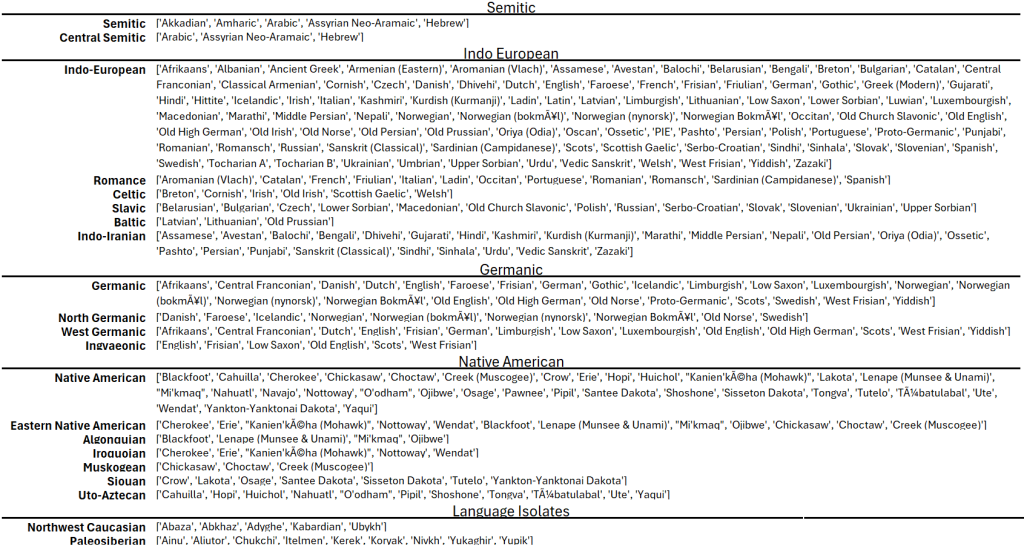
Therefore, if the average similarity between two language families is underneath 1.0, that indicates that the families are probably related. To figure out the probability that they truly are related – and not that they just happened to look related – I first created a list of similarity-scores between every single langue in one family with every single language in the other family. I then used a t-test on this list of similarities testing if its average is underneath 1.0 to see if they are related. This creates the p-value in my tables called “p-value language is related”.
A p value is the chances that a statistical relationship could have occurred by chance. Therefore, since the “p-value language is related” between semitic languages and eastern native American languages is 0.74%, that means that these two groups are so related to each other that there is only a 0.74% chance that this relationship could have happened by chance [usually, in statistics, the p value has to be underneath 5% for a relationship to be considered “statistically-significant”, therefore this relationship is very statistically significant].
As you will see, many language families are statistically significantly related to semitic languages. Therefore, to generally test if [family A] is more related to [target family] than the average of other families, I created a separate test: I got the average similarity score of each language in family A to the target language group (in this case, semitic languages), thus forming a list and did a t-test on whether that list of values is underneath the global average similarity to the target family. This creates the p-value in my tables called “p-value closer than average of other language groups”. Thus, since the “p-value closer than average of other language groups” that semitic languages are closer to eastern-native American languages than other languages is 0.52%, that means that not only are semitic languages and eastern-native American languages related, but also that they are related a lot more than other languages tend to be related to eastern native American.
To explain the difference between these two statistics: the p value going into “p-value language is related” between semitic languages and eastern native languages comes from testing whether a list of 60 numbers representing language similarity has a mean underneath 1.0, since there are five semitic languages, twelve easter-native American languages, and therefore 5×12=60 pairs of languages between the families.
However, to compute “p-value closer than average of other language groups” for whether semitic languages are closer to eastern-native American languages, I only use a list of 5 numbers, testing whether their mean is underneath the global mean average to eastern native american languages (which is 0.9995 across the 135 non-Eastern American languages in my dataset). Each number in the list corresponds to one of the five semitic languages in my dataset, and the number equals the average similarity score of that language across the twelve eastern-native American languages.
To illustrate further the difference between these p values, I present to you the scenario of where I find the closest language families to English, and look specifically at Slavic languages. The “p value language is related” between English and the Slavic language family is 0.000002%, because they are both Indo-European languages and so their words do indeed resemble each other. However, the “p value closer than average of other language groups” between English and Slavic languages is 99.998%, because most of the languages in my dataset are Indo-European, and Germanic languages are far more similar to English than Slavic languages are.
Results
Closest Families to Semitic Languages
Without further ado, here are the languages families closest to Semitic:
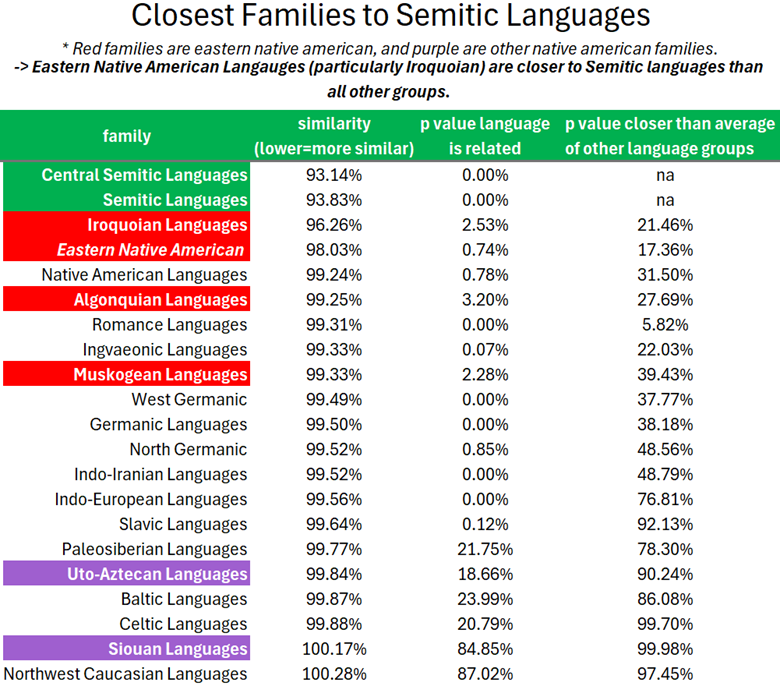
As you can see, besides other semitic languages themselves, eastern native American languages are indeed the most similar languages to semitic languages (with a p value of 0.74%). [to note: Iroquoian languages are a subgroup of Eastern Native American languages.]
It also appears that all Indo-European language groups are similar to Semitic languages, thus proving that the Indo-Semitic hypothesis is true – Indo-European languages have a common ancestor with Semitic languages. And for the skeptics: it really must be that they are related ancestrally, and not that some of their words resemble each other due to trade for the following reasons: 1) This applies to almost all branches of Indo-European, and while it’s possible that perhaps Romance peoples traded with Semites, it is very unlikely that North Germanic peoples did. 2) This analysis only looks at the core 207 word vocabulary, which is much less likely to be influenced by trade than less common words would be (for example, even though approximately 5-10% of words in Afrikaans come from Malay, precisely zero of the core 207 words in Afrikaans come from Malay). And 3) North-west Caucasus languages are not affected by Semitic, even though they likely would have had much closer contact with Semites than Germanic peoples.
And to note what should be obvious: the reason why the p-value that Eastern Native American languages are closer than other language groups to Semitic is higher (17.36%) is because East Native American languages are not the only languages ancestrally related to Semitic languages. This doesn’t affect the hypothesis of this paper – which is that East Native American languages come from Semitic. Rather, the hypothesis remains supported, given that the [p-value language is related] for the two groups is very low (0.74%).
Closest Families to Eastern Native American Languages
The relationship between Native American languages and Semitic Languages is becomes much more apparent when we look at the closest languages to eastern native American:
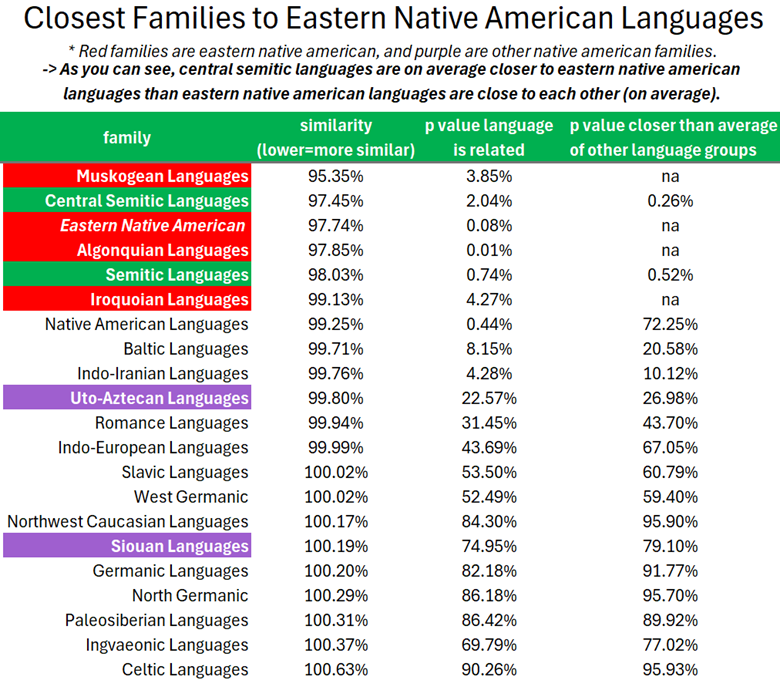
As you can see, semitic languages are again very similar to east native American languages (p value 0.74%).
Moreover, semitic languages are also far more similar to east native American languages than the other groups, with a p-value of 0.52%.
Interestingly, central semitic languages (of which Hebrew is a member) are so close to eastern native American languages, that they are actually on average closer to eastern native American languages than eastern native American languages are with each other (central semitic languages have a similarity score of 97.45%, whereas eastern native American languages have a similarity score with each other of 97.74%).
Furthermore, the non eastern native American language groups, which are Uto-Aztecan and Siouan, appear to have no relationship to Eastern-Native American languages, nor do Paleo Siberian Languages (which you might have expected to have a relationship with east-native American languages, since secular people believe Native Americans came from Siberia).
This proves that eastern native American languages are a branch of Semitic languages.
This is not because native American languages share a distant common ancestor with Semitic, because if they did, then you would also expect easter native American languages to be related to Indo-European languages – since, as shown, Indo-European languages actually do share a common ancestor with Semitic languages. But this is not the case: eastern native American languages do not appear to be linked to Indo-European languages. Thus, eastern native American languages must literally descend from Semitic languages.
Closest Languages to Eastern Native American Languages
Here are the most similar languages to eastern native American languages (that are not themselves eastern native American languages):
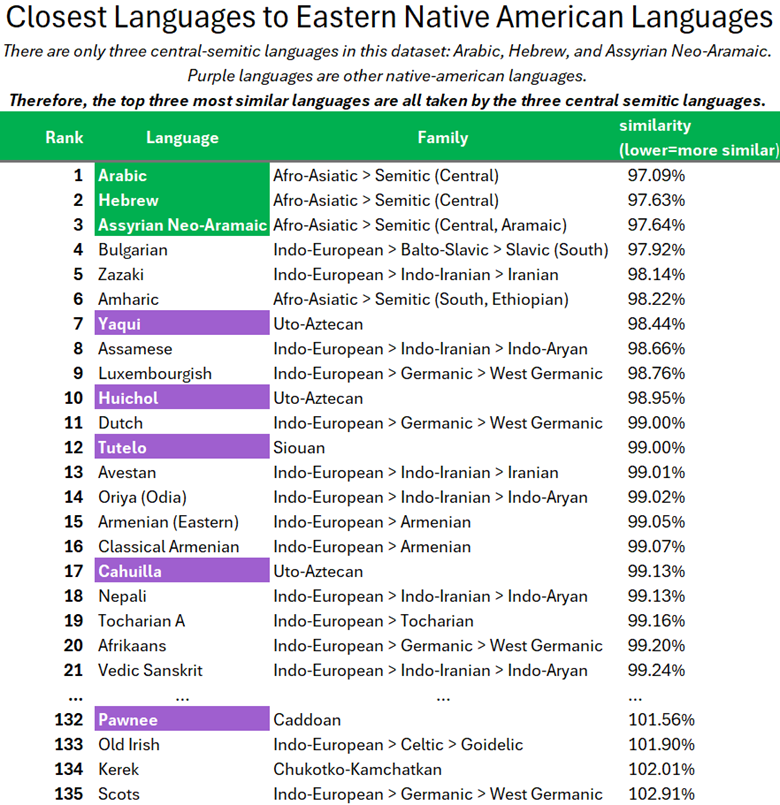
Thus, of the three languages which are central Semitic, these are precisely the same top three languages which are most similar to eastern native American languages!
Interestingly, if we look at Akkadian, which is the singular east semitic language in my dataset, it is actually ranked #39. Thus, east semitic languages are not really related to native American languages; only central semitic languages are related to eastern native American languages (and to a lesser degree south semitic languages).
To belabor the obvious, this means that eastern native American languages must directly come from south-central semitic languages. They cannot merely come from a common ancestor with semitic languages, because if that was the case, then we would expect to see native American languages to also be similar to east semitic languages, except this is not the case.
Iroquoian Languages
Since the most similar family within eastern native American languages to Semitic was Iroquoian, it is interesting to specifically look at which families are closest to Iroquoian:
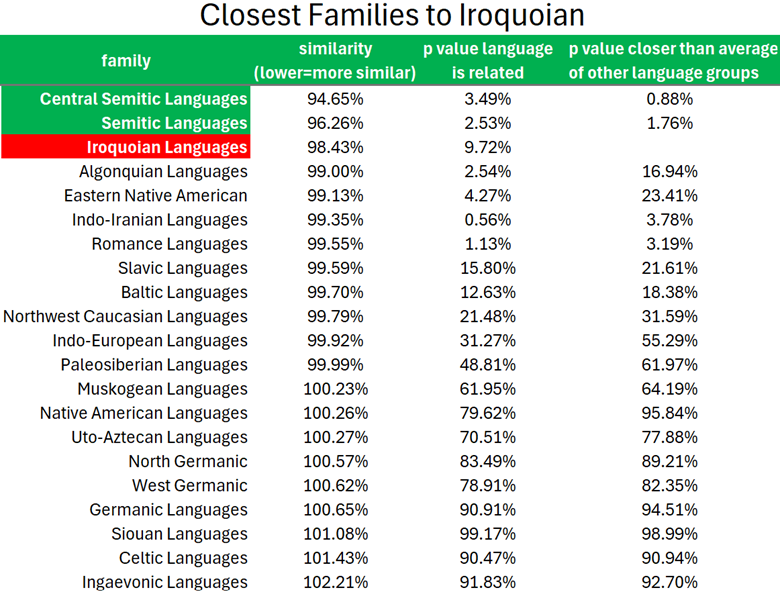
Amazingly, Iroquoian languages appear to be more similar to central Semitic languages than they are to each other (their similarity score with each other is 98.43%, while their score with central semitic is 94.65%), echoing how the broader umbrella of eastern native American languages are also more similar to central Semitic than they are with each other. Or in other words, if I compared one Iroquoian language to another random Iroquoian language, they would sound less similar to each other than a random Iroquoian language would on average sound to a random central Semitic languages.
This again illustrates how east native American languages don’t merely come from a common ancestor with Semitic, but instead literally descend from central Semitic. If they simply came from a common ancestor, then I would still expect Iroquoian languages to be more related to each other than they are to Semitic languages. However, if they literally descend from central Semitic, then it actually might be realistic to expect them to be more similar to central Semitic than they are to each other – in the same way that you would expect all Romance languages to be more similar to vulgar-Latin than they are to each other, since they originally came from different dialects of vulgar Latin.
Comparison to English
To understand the degree to which Iroquoian Languages resemble central Semitic languages, it is helpful to look at how similar various language families are to English:
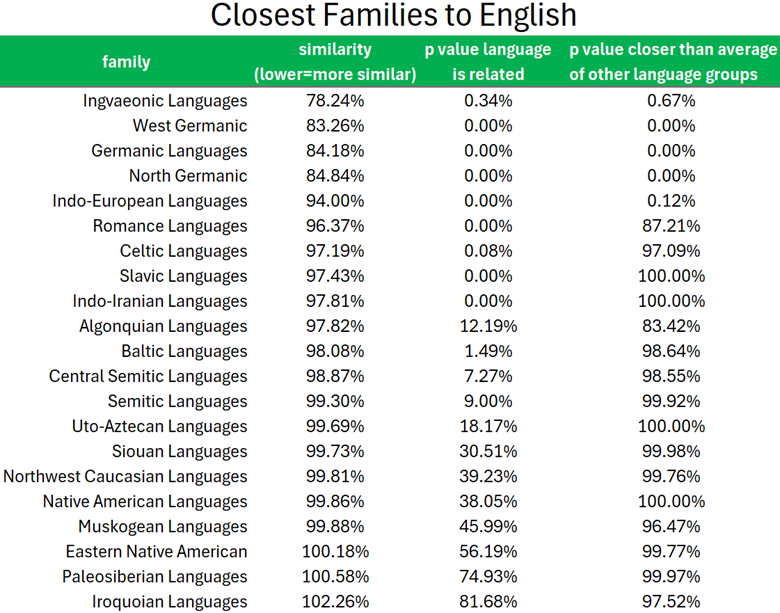
For context: English is an Ingvaeonic language, which is a subset of West Germanic languages, which is a subset of Germanic languages, which is a subset of Indo-European languages. Thus, it makes sense for English to be most related to these families in that order.
Thus, since the similarity between central semitic languages and Iroquoian languages is 94.65%, Iroquoian languages and central semitic languages are less similar than English is to Germanic languages, but more similar than English is to all other branches of Indo-European languages (having learned Portuguese, I can attest that English and Romance languages are surprisingly similar).
Hence, if it makes sense to you for English to be a branch of Indo-European languages, then it surely should also make sense for Iroquoian languages to be a branch of central Semitic languages.
Conclusions
In the spring of 1820, Joseph Smith asked God in prayer which denomination was true, and received a vision of God and Jesus Christ, where he was told that all of the Christian sects had become corrupted. This set into a motion a series of events in which Joseph was angelically guided to discover hidden in a hill in upstate New York an account written on gold plates of Jews who lived in the Americas and had the gospel. This account was intended by God to correct the mistakes that modern Christians had made in their interpretations of the Bible. After Joseph Smith translated the account via the spirit of revelation into English, this account came to be known as the Book of Mormon and was published in March 1830. This account contains the history of these Jews – who called themselves Nephites – including how they arrived in America, their wars and contentions, their governance, their visitations from prophets and even Jesus Christ, and their final destruction after they fell away from the gospel.
Since Joseph Smith published the Book of Mormon, there now been nearly two hundred years of debate on whether the Book of Mormon is true or if Joseph Smith was a fraud – a debate which has turned family members against each other, and which has come to define the lives of many lay people and also academics, both amongst those who believe the Book of Mormon and also those Ex-Mormons who call themselves Anti-Mormons.
This paper puts all of that debate to rest.
Quantitative linguistics shows that eastern North American native languages descend from central Semitic languages – which could only be possible if either a group of Jews or a group of people who spoke the same language as the Jews migrated from the middle east to the Americas – exactly as claimed by the Book of Mormon.
Moreover, the most similar language group to Semitic, out of all the native American language groups studied, was Iroquoian. The home territory of the Iroquois was western New York – the exact place where Joseph Smith claims to have found the gold plates.
In light of the findings of this paper, I suppose the most realistic objection to the Book of Mormon is to claim that Joseph Smith happened to get lucky in his prediction that Semitic peoples moved to the New World. But what are the chances that not only was Joseph Smith right that Semitic peoples moved to the Americas, but also that the place where Joseph Smith claimed to have uncovered their records is the very place where native American languages are closest to Semitic?
Unfortunately, the most common objection to this paper probably is dismissal: I don’t know what is wrong with your statistics, but there probably is something wrong with them, and I don’t care enough to try to figure out what it is.
I suppose my response is that I really have tried to be as open and straight forward as possible in my analysis, and I also include attached at the end all the code and data used to produce these statistics.
The truth is, when this research was first conceived, it had a vast potential to falsify the Book of Mormon. But it didn’t. This is how I find truth: I gather evidence, I evaluate it, and I choose to believe whatever appears to be supported by the most evidence. But that is not how most people I know evaluate the world: most people just believe whatever is popular and then they have an insurmountably high degree of evidence needed to believe otherwise (but of course they only need the flimsiest shadows of evidence to believe things supported by institutions, and as a result of this double-standard, will reject mountains of evidence for the silliest excuses imaginable, but I digress…).
Then, if you start to approach having the incredible degree of evidence that they demand of you, they all the sudden stop caring about the evidence and shut down the conversation with the typical: I don’t know why you are wrong, but I think you are, and I don’t care enough to research this.
I also have compiled a great number of facts which prove that the Book of Mormon is true in Secular Evidence for the Book of Mormon, as well as Statistical Analysis of 368 Accounts of the Flood Proves both the Book of Mormon and the Bible are True.
So all of this probably will not convince the great many people who have hard hearts towards anything they don’t already believe. This reminds me of how once I told a college professor about a meta-analysis of 26 studies showing something supernatural, and their response was that there could have been 28,000 studies and only the top 26 were published. Which is first of all crazy, nobody is every going to do 28,000 studies on a fringe topic like this. But more importantly, they ignored here the whole point of meta-analyses in the first place: to evaluate publication bias – whether it’s realistic or not to dismiss the results of research due to said bias; in other words, it doesn’t make sense to reject a meta-analysis because of a fears of publication bias since the whole point of meta-analyses is to address the potential of publication bias. If 26 studies couldn’t convince this professor, then there probably isn’t anything in the entire world that you could show him which would persuade him to believe in the supernatural.
I suppose therefore that this research is not intended for the masses. Only the elect – those who recognize truth when they see it – will be open towards this paper being true.
All I can do is testify that I for myself have received a spiritual witness that the Book of Mormon is true, through feelings, dreams, and even a vision (which I discuss in Why I Believe the Book of Mormon is True).
And I promise to you, my dear reader, that if you read the Book of Mormon, sincerely, with an open heart, asking God with real intent if it is true after reading it, you will also receive for yourself a witness of its validity. Reading the Book of Mormon changed my life, and I am extremely grateful that I was born into a tradition which led me to read it. Therefore, I invite you, my dear reader, to also read the Book of Mormon.
* Also, to see why the Book of Mormon is important, I encourage you to read 7 Essential Principles from Mormonism.
Thanks for reading this, and I hope you have a wonderful day, God bless you!
* see part 2 of this work at Quantitative Linguistics shows that many Native American Language Families are Germanic
Leave a Reply