
According to my dreams, I have learned that many native American languages are close to old German and specifically old English (Short Dreams from July and Linguistics of Native Americans and Recommencement of Animal Sacrifices). In Linguistics of Native Americans and Recommencement of Animal Sacrifices, I saw myself doing an analysis of languages in the Americas to see if they resembled Germanic languages, thus inspiring me to conduct the following analysis on whether native American languages resemble Germanic.
The first part of this analysis is Quantitative Linguistics shows Eastern Native American Languages are Semitic, Proving the Book of Mormon is True. As such, for brevity I won’t repeat myself in explaining my data and methods in this paper, since those are all already explained in the first part, which I encourage you to read.
And to note, since in the first part of this analysis I demonstrated that Iroquoian languages are Semitic, I will largely be ignoring Iroquoian in this present paper.
General Similarity with Germanic
This chart shows which families are most similar to non-Iroquoian native American families:
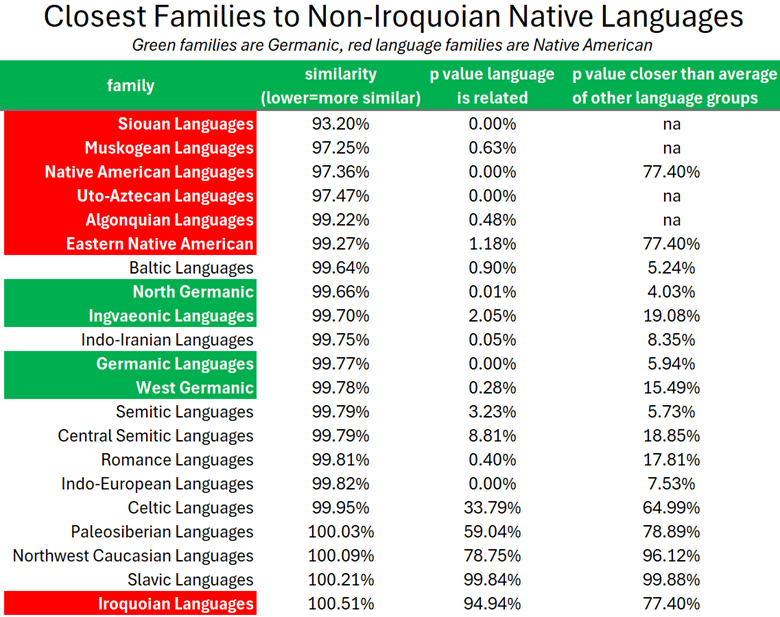
As you can see, Germanic does appear to be related to these families (with a p value of 0.003%), however, it is hard to say whether these languages actually come from Germanic, since other Indo-European branches (particularly Baltic) are also very similar.
Iroquoian languages likely are the least similar family to the rest of the native American languages because Iroquoian languages are central Semitic (as shown in Quantitative Linguistics shows Eastern Native American Languages are Semitic, Proving the Book of Mormon is True), and therefore have a completely different origin from the rest of the native American languages.
In order to truly discern whether some native American languages come from Germanic, rather than them simply sharing a common ancestor with Indo-European, it is now necessary to look at each of the five native American language families in my dataset: Siouan, Uto-Aztecan, Algonquian, Muskogean, and Iroquoian Languages.
Each of the five native American language groups
Siouan Languages
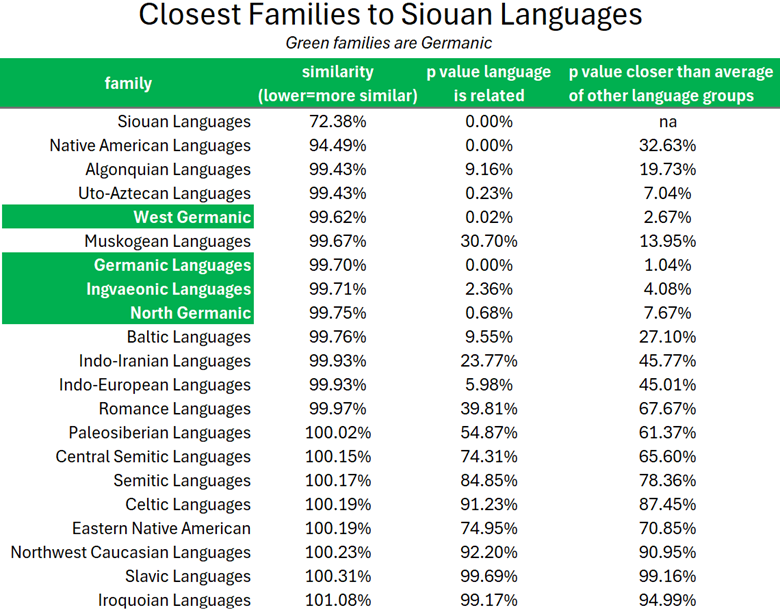
As you can see, Siouan indeed appears to have come from Germanic. Moreover, the p-value that Germanic languages are related is 0.00%, whereas the p-value for every other branch of Indo-European is high, implying that Siouan actually did come from Germanic rather than simply having a common ancestor with Indo-European.
Uto-Aztecan Languages
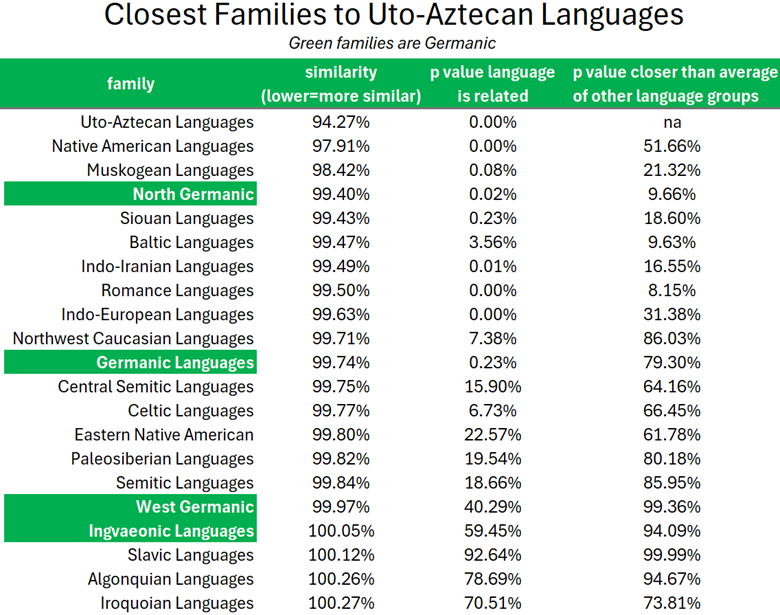
Uto Aztecan appears to be related to Germanic, but it also seems to be related to other branches of Indo-European.
Algonquian Languages
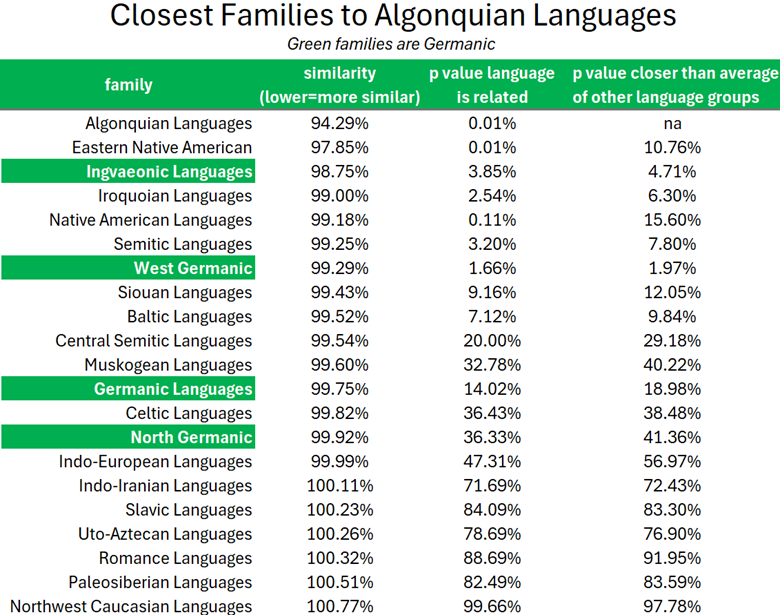
Algonquian appears to have come from west Germanic, and not north Germanic. Since the p value is high for all the other branches of Indo European, I conclude that Algonquian really did descend from West Germanic, as opposed to simply having a common ancestor with Indo European.
Muskogean Languages
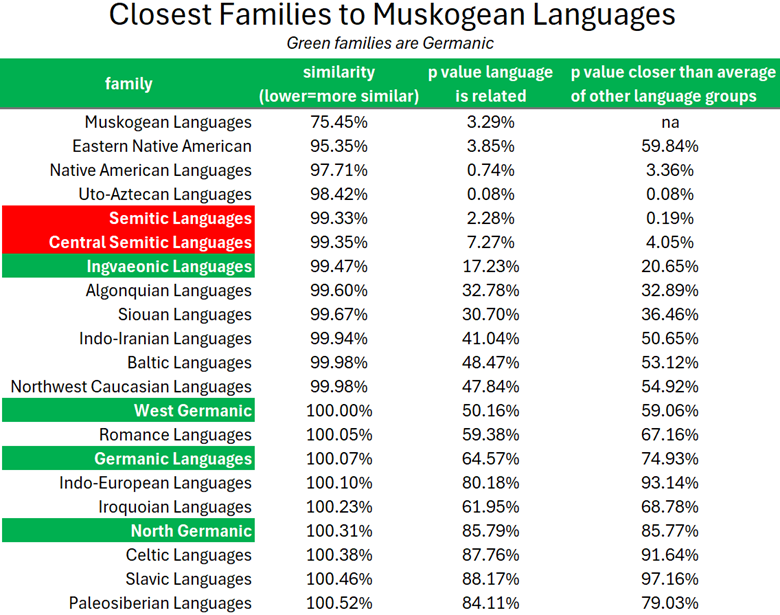
Muskogean appears to be semitic.
Iroquoian Languages
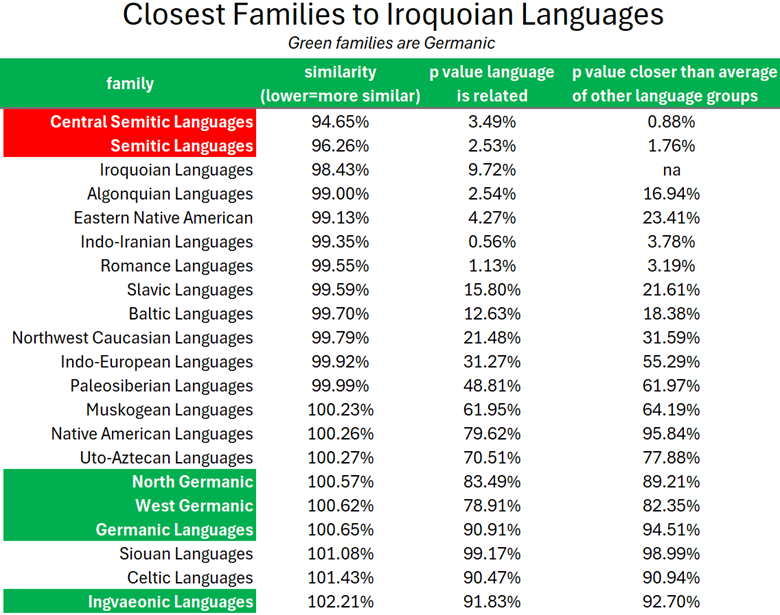
Iroquoian appears to very much be Semitic.
Interpreting the Charts
Therefore, here is the correspondence of native American families to Eurasian families:
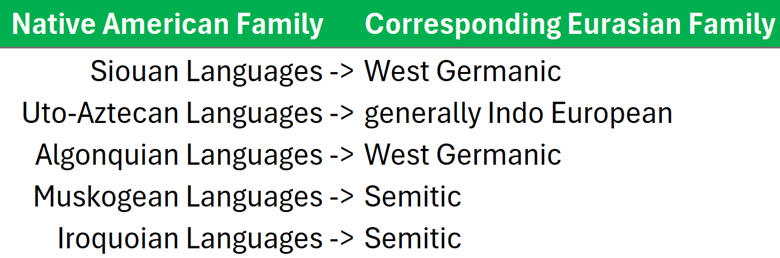
Thus, amazingly, my statistics link every single North American native language family in my dataset to a Eurasian language family (and if you doubt this conclusion, I refer you back to my charts and their associated p values that the languages are related).
Genetic Evidence
If you doubt all this, I also present unto you haplogroup R:
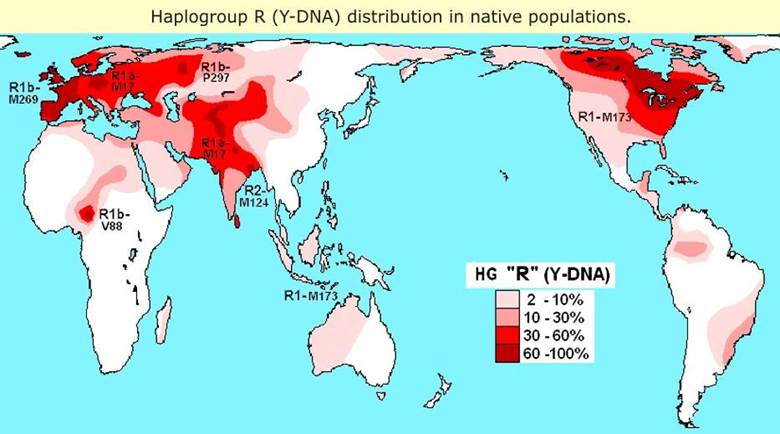
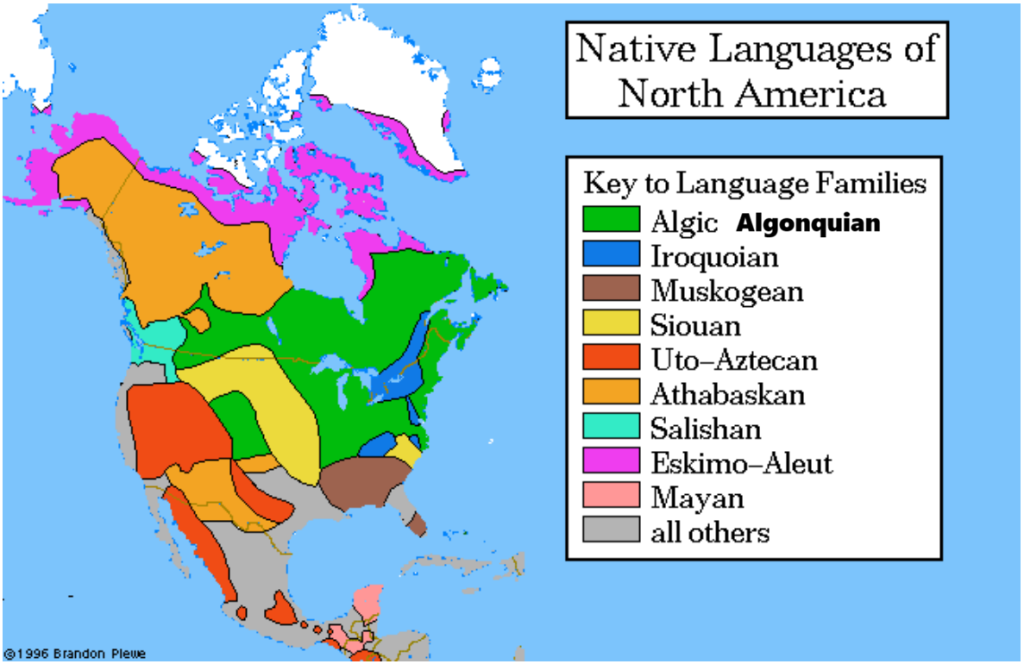
Since haplogroups measure common the common maternal ancestor of peoples, this graph shows that (many) of the Indians in Nort-East America share a common ancestor with western Europe. And just to emphasize, this map perfectly corresponds with my theory, in that the haplogroup R area of North America is the precise area of America where the Siouan and Algonquian peoples lived, and the haplogroup R area of Eurasia is specifically concentrated in the region where western Germanic peoples live.
You can see that the Siouan and Algonquian peoples lived in this region from the below map:
Conclusions
This research confirms my beliefs that some of the native American languages descend from western Germanic. I suppose therefore that a Germanic people must have once settled the Americas long ago, but they were then somehow corrupted, leading them to lose civilization and physically lose their resemblance to European Germanic peoples. Honestly though, I simply don’t know why this is all the case.
I will however shout out one author who has somehow known all along that Native American languages are Germanic. His name is Frederick Dodson, and he wrote the books The Lost Secret of Ancient German and Extraterrestrial Linguistics: and the Secret of Human Origins, which both I think claim that native Americans spoke Germanic. I must confess that I have never actually read any of his books, but I do know a little bit about his views on linguistics from reading his blog falsehistory.net.
End Note – Our Proto-Germanic Reconstruction is Terrible!
The oldest Germanic languages I have in this analysis are:
- Gothic: 350–380 AD; east Germanic language.
- Old High German: 750–800 AD; west Germanic language.
- Old English: 700–750 AD; Ingvaeonic west Germanic language.
- Old Norse: 1150 AD; North Germanic language
Therefore, I would expect these to be the closest languages to the Proto-Germanic reconstruction, yet they are not. Here is a graph of the most similar Germanic languages to each of these candidates for oldest Germanic language, all ranked by similarity, with the most similar languages at the top of the list:
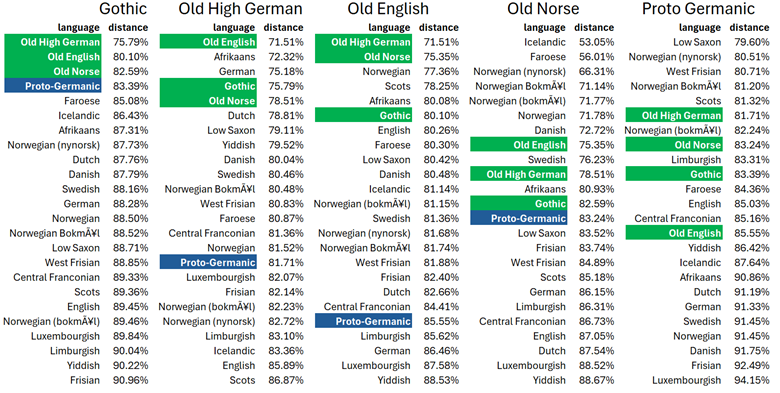
As you can see, the proto Germanic reconstruction is in all cases the least similar to the very old languages in my analysis compared to the other options for old languages (Gothic, Old High German, Old English, Old Norse). Therefore, it appears to me that our reconstruction is not great.
If we therefore assume that Gothic is a better proxy for Proto-Germanic than the reconstruction is, then it appears that Old English is closer to Proto-Germanic than Old Norse (contrary to public opinion), and that Afrikaans is the closest widely spoken language to Proto Germanic. This reassures me, since these are indeed the two specific languages for which I have dreamt:
Afrikaans – Great Faith Makes Great Wisdom is our World
Old English – Short Dreams from July
Also, if you are curious about which languages are the most efficient, visit Language Efficiency Map. In short, English and Afrikaans appear to be the most efficient languages, and Old English is the most efficient language which has a functional case system.
Thanks for reading, I hope you have a wonderful day, and God bless you!
Leave a Reply